Case handling is one of the most common conveyor applications — and one of the easiest to underspecify. Cartons, totes, and cases come in a huge variety of sizes, weights, and bottom conditions, and a conveyor that’s perfect for one product can perform poorly on another.
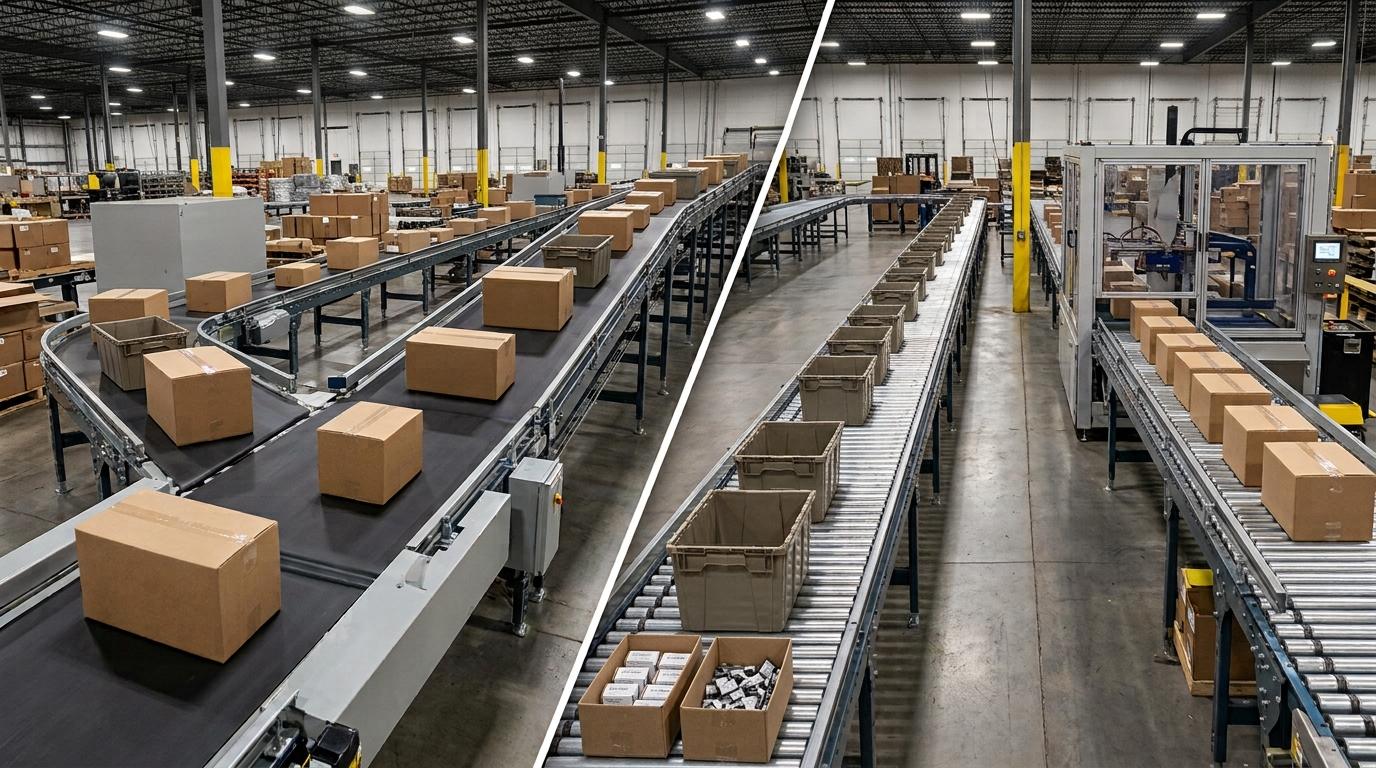
Belt conveyors remain the most versatile option for case handling. A flat, continuous carrying surface supports a wide range of package sizes and bottom conditions — including soft-bottomed bags, irregularly shaped cartons, or cases with open bottoms. Belt conveyors also handle inclines and declines well, making them the go-to choice for elevation changes in a case line.
Powered roller conveyors offer distinct advantages where accumulation is needed. Zero-pressure accumulation (ZPA) roller zones allow cases to queue without back-pressure damage — critical in lines that feed automated packaging or palletizing equipment where timing matters. Roller conveyors are also easier to maintain, with individual rollers replaceable in minutes.
For smaller cases and consistent package sizes, lineshaft-driven roller conveyors offer an economical alternative with simple, reliable drives and easy speed adjustment. They’re common in distribution centres where throughput is moderate and product size is controlled.
Don’t overlook transitions. The handoff between conveyor sections — particularly at merges, diverters, or transfers — is where most case handling problems originate. Proper nose-bar design, roller pitch, and belt speed matching at each junction will keep your line running smoothly and reduce product jams.
At GCCL, we design case handling systems with the full production flow in mind — from in-feed through to palletizer or shipping dock. Contact us to discuss your requirements.